If you run a business website today, you’ve probably heard terms like SEO, GEO, and AEO everywhere.
At first, they sound confusing - and honestly, many people think they all mean the same thing.
But they’re actually different ways of helping people find your business online.
The good news?
You don’t need to be a technical expert to understand them.
Let’s break it down in a simple way.
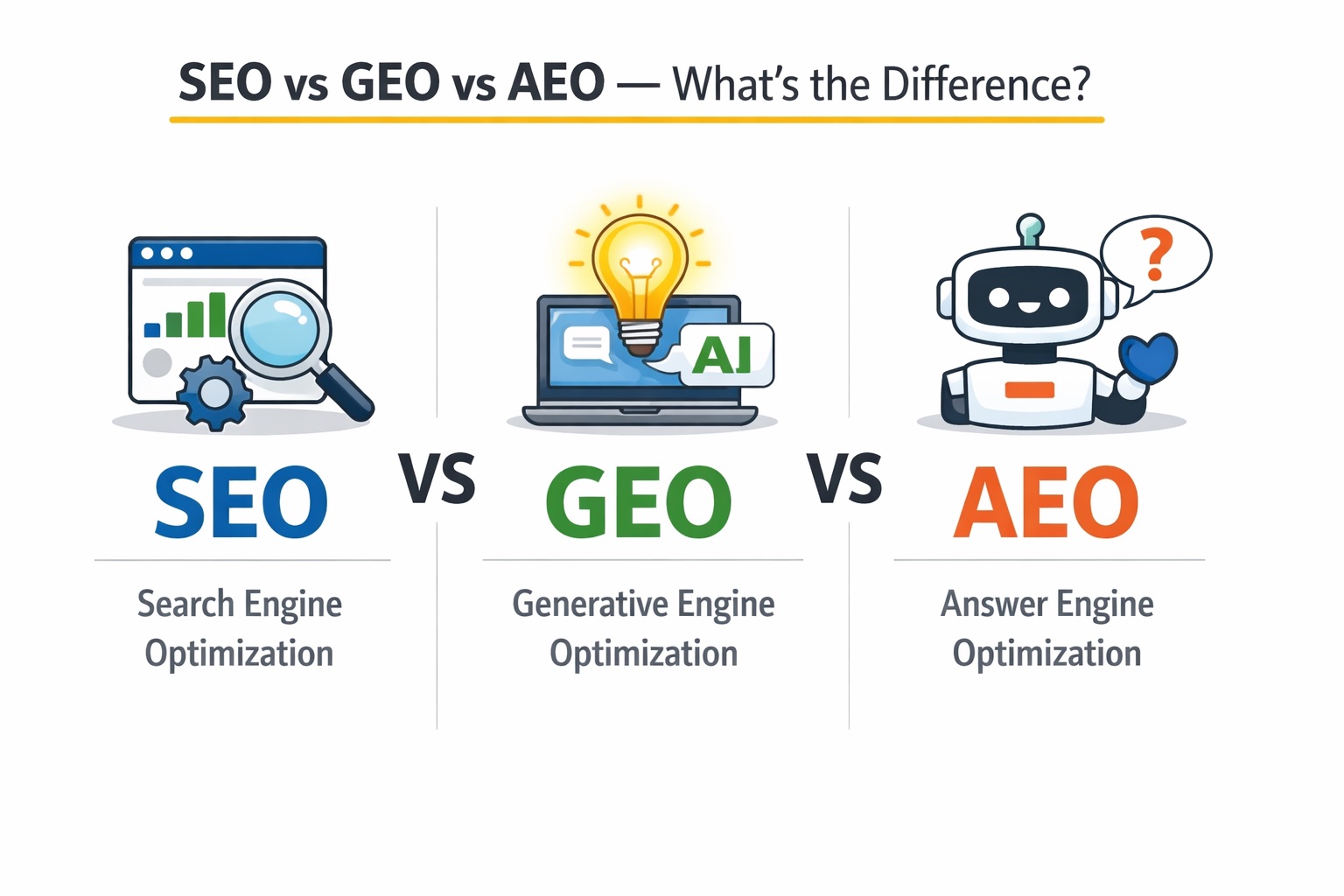
SEO - Search Engine Optimisation
SEO is the traditional way of improving your website so it appears on search engines like:
When someone searches:
best bakery in Dubai
Search engines scan millions of pages and decide which websites should appear first.
SEO helps your website become one of those top results.
SEO focuses on things like:
Using the right keywords
Fast website speed
Mobile-friendly design
Helpful blog content
Good page titles and descriptions
Backlinks from other websites
Simple example
Imagine you own a flower shop.
SEO helps your website appear when someone searches:
“flower shop near me”
“Buy roses online”
“wedding bouquet UAE”
The better your SEO, the easier it is for people to discover your business through search results.
AEO - Answer Engine Optimisation
Now people are no longer only searching on Google.
They’re asking questions directly to AI assistants and voice assistants like:
Instead of showing 10 blue links, these systems try to give one direct answer.
That’s where AEO comes in.
AEO means structuring your content so AI systems can easily understand and use it as an answer.
AEO focuses on:
Clear questions and answers
Simple language
FAQ sections
Structured content
Short and direct explanations
Trusted information
Simple example
Someone asks ChatGPT:
How often should I water indoor plants?
If your website has a clear and well-written answer, AI systems may use your content when responding.
That’s AEO.
GEO - Generative Engine Optimization
GEO is the newer concept.
It focuses specifically on Generative AI in Search experiences.
Today, AI tools don’t just show links - they generate full answers by combining information from different websites.
For example:
These systems summarise information for users instantly.
GEO helps your content become part of those AI-generated responses.
GEO focuses on:
High-quality original content
Authority and trust
Clear brand information
Context-rich articles
AI-readable structure
Up-to-date information
Simple example
Someone searches:
Best ways to improve WordPress security
An AI search engine may generate a complete answer using information from several trusted websites.
If your article is helpful and well-structured, your brand could be included in that generated response.
That’s GEO.
The Easiest Way to Understand It
Think about it like this:
Type | Goal |
|---|---|
SEO | Help people find your website in search results |
AEO | Help AI assistants answer questions using your content |
GEO | Help AI-generated search experiences include your brand/content |
Do You Need All Three?
Yes - especially now.
The internet is changing fast.
A few years ago, ranking on Google was enough.
Today, people also ask AI tools directly before visiting websites.
Modern businesses should optimize for:
Search engines
AI assistants
AI-generated search experiences
The good news is that good content helps with all three.
How to Improve SEO, AEO, and GEO Together
Here are some simple tips that work across all of them:
Write helpful content
Focus on solving real problems instead of stuffing keywords everywhere.
Use clear headings
Organized content is easier for both people and AI to understand.
Answer common questions
FAQ sections are great for AEO and GEO.
Keep your website fast
Nobody likes slow websites - including search engines.
Make content easy to read
Simple language usually performs better than overly technical writing.
Final Thoughts
SEO is not dead.
But search is evolving.
People now discover businesses through:
Traditional search engines
AI assistants
AI-generated answers
That’s why understanding SEO, AEO, and GEO matters.
You don’t need to master complicated algorithms.
Just focus on creating genuinely useful, trustworthy, and easy-to-understand content.
In the long run, that’s what both humans and AI systems prefer.